 English
 Italiano
 Latina

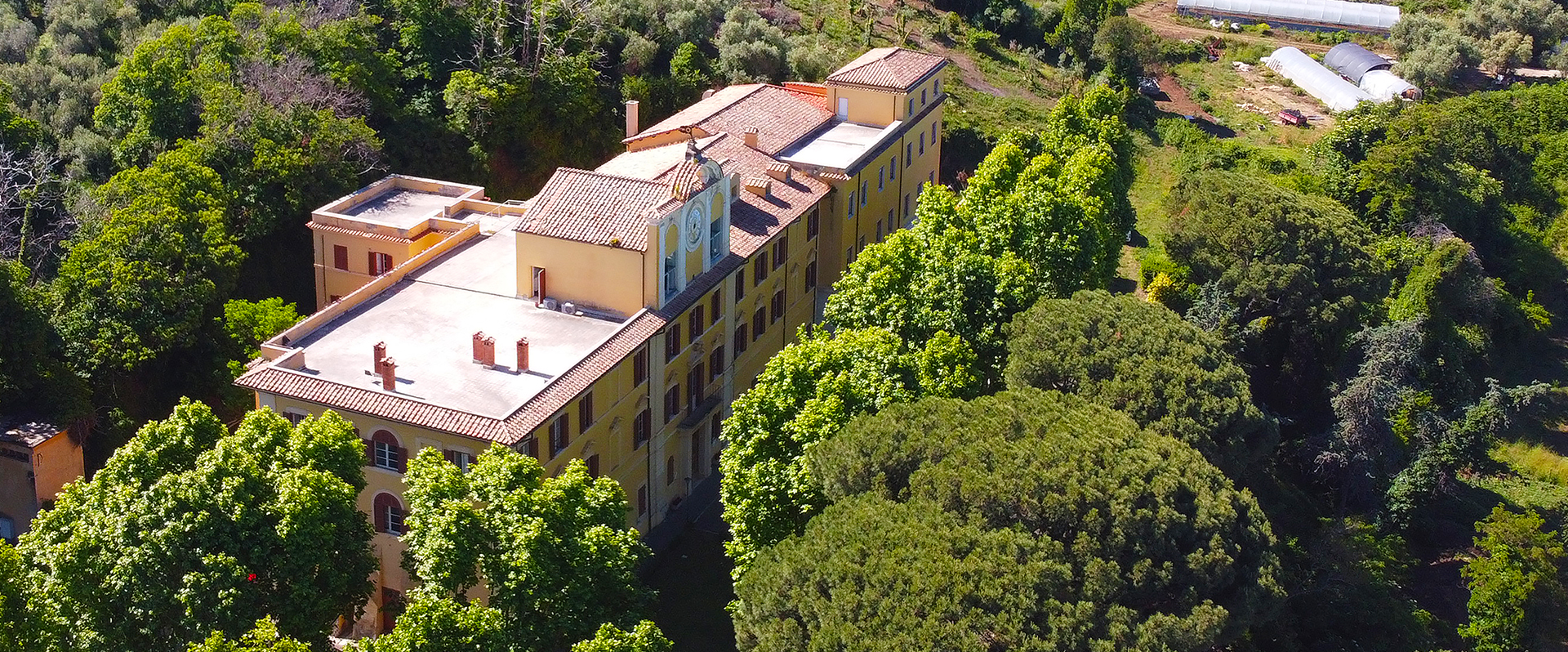
Villa Lucidi
Short history
The original part of the building was constructed in the 17th century on the ruins of the great Roman villa of the Vinicii, on a much smaller scale than the present-day structure, by Francesco Lucidi, who had leased a small plot of farmland situated along the road between Frascati and Monte Porzio Catone, in an area renowned since antiquity for the fertility of the soil and the ruins of Roman villas, on which new buildings were erected during the 16th and 17th centuries. The landowners in the area were the powerful Borghese family, who had already commissioned a large villa near Frascati (now Villa Borghese-Parisi). It was indeed to the Borghese that villa Lucidi and its adjoining vineyards reverted when a life of excesses reduced both Francesco Lucidi and his son Giovanni Prospero to poverty, with the latter passing away around 1700.
The building, by then in a dilapidated state, lay disused until 1754, when Camillo Borghese sold it for the modest sum of 700 scudi, together with a small plot of land measuring “tre scorzi” (approximately 35,000 square metres). The buyer was the Collegio Clementino, an institution that had been founded in 1595 by Clement VIII and entrusted to a distinguished religious order from Somasca (Bergamo), dedicated to the education of promising youths, who in the summer would leave their college in Rome to rest in the Alban hills.
In the years following the purchase, restoration work was carried out by the architect Giuseppe di Filippo Scaturzi (ca. 1731–1794), and in 1765 the building, which had been extended and refurbished, was ready for use, along with the surrounding fruit-orchards and olive groves that had also been acquired in the meantime.
Situated on a “pleasant and delightful hillock”, the great villa of the Somaschi Fathers was “of a beautiful design, comprising the Oratory, the Hall, the Bedrooms, the Refectory and other rooms that embellish it”, as recorded on 1 October 1768 in the “Daily Journal” published by the Chracas family.
In 1873, following the dissolution of religious institutions, the newly founded Italian State confiscated the assets of the Collegio Clementino, which were restored in 1891 under the new name of Convitto Nazionale. As a holding of the Convitto, Villa Lucidi retained its use as summer retreat for the recreational activities of the boarders of the college. During the Second World War, the villa was repurposed as a military hospital, before being entrusted, after the end of the conflict, to the Italian Ministry of Education, which expanded it by adding a new wing and used it until 2012 as a teacher training centre, operating in conjunction with Villa Falconieri, which, for its part, had previously housed the European Centre for Education (CEDE), and subsequently the National Institute for the Evaluation of the Education System (INValSI).
Activities
After a long period of neglect and disrepair, in 2023, the villa was entrusted to the Accademia Vivarium novum which is gradually restoring it and established there the Centre for the Study of Classicism, the Centre for the Study of Ancient History and Inter-Civilisational Relations, parto of the Poikile project for the rebirth of the visual arts and architecture, as well as libraries and part of its extensive book holdings, classrooms and a lecture hall that will host educational activities and international academic conferences, as part of the 'Global Campus of the Humanities' currently taking shape in the Tusculan area under the aegis of the Vivarium novum.